🏠 Home → Equipment → MODBUS Utility
¶ Device Description
The ROSSMA IIOT-AMS MODBUS Utility meter-switch is designed for automated data collection from utility metering devices via RS-485 interface with subsequent wireless transmission over LoRaWAN or NB-IoT networks.
The device is specially designed for housing and communal services (HCS) metering systems and commercial energy resource accounting.
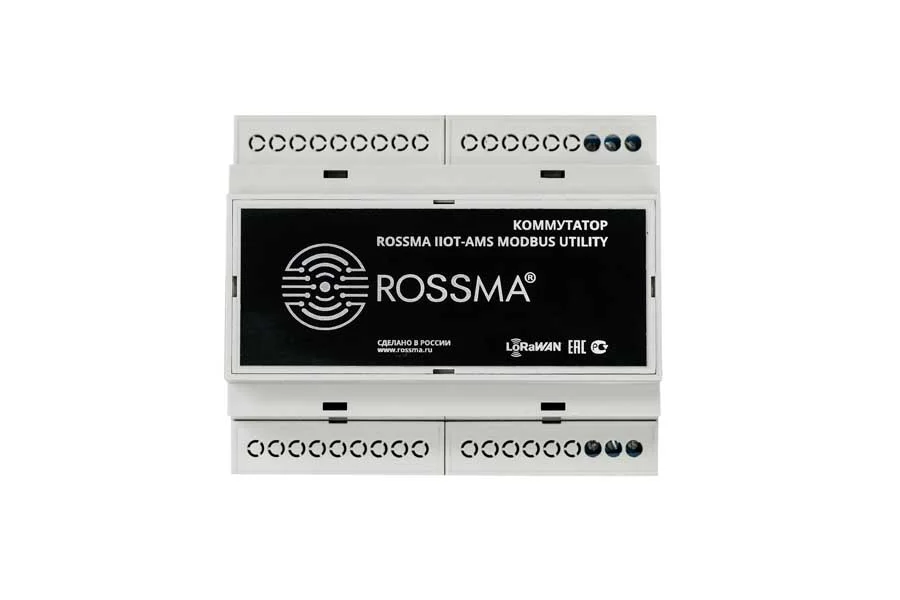
Fig. ROSSMA IIOT-AMS MODBUS Utility meter-switch appearance
¶ Compatible Metering Devices
¶ Electricity Meters
- Mercury (230, 234, 236, 200)
- Energomera (CE102, CE301, CE303)
- Matrix (NP)
- Incotex (Mercury 201, 203, 206)
- ABB (A, B, C series)
- Schneider Electric (PM/EM series)
- Other meters with RS-485 interface and Modbus RTU protocol
¶ Heat Calculators
- SPT (941, 942, 943, 961, 962, 963 series)
- VKT (7, 9)
- Pulsar (TK, TM)
- Vzlet (TSR, TSR-M, TSRV)
- Teplokom (MIR, TV7)
- KMCh (Heat meter)
- Other heat meters supporting Modbus RTU
Equipment is registered in the register of the Ministry of Industry and Trade of the Russian Federation as equipment manufactured on the territory of the Russian Federation (Conclusion 48859/11 dated June 11, 2021).
¶ Technical Specifications
¶ Connection Interfaces
- 1 serial interface: RS-485 (Modbus RTU)
- Discrete inputs: 3 multifunctional inputs (pulse counting or status monitoring)
- Built-in temperature sensor: yes (sent with each transmission)
- Power voltage measurement: yes (battery status monitoring)
¶ Electrical Characteristics
- Supply voltage (mains): 230 V, 50 Hz
- Supply voltage (autonomous): 3.3-3.6 V (built-in battery)
- Power consumption (mains): 62.7 W
- Power consumption (autonomous): 0.99 W
- Current consumption (autonomous): 0.3 A
¶ Operating Characteristics
- Operating temperature range: -55…+80°C
- Relative humidity: up to 95% at +25°C (non-condensing)
- Atmospheric pressure: 84...106.7 kPa
- Protection degree: IP65 (industrial), IP66 (explosion-proof)
- Explosion protection marking: 1Ex e IIC T4 Gb X / 1Ex db IIC T5 Gb X
¶ LoRaWAN Characteristics
- Device class: A or C
- Frequency plan: RU868, EU868, IN865, AS923, AU915, KR920, US915, KZ865
- Activation method: ABP or OTAA (configurable), default ABP
- Transmission interval: configurable via LoRaWAN (from 1 minute)
- Receiver sensitivity: -138 dBm
- Radio range: up to 5 km in urban areas; up to 15 km in rural areas
- Transmitter power: 25 mW (default), maximum 100 mW
¶ NB-IoT Characteristics
- Frequency bands: B1/2/3/5/8/12/13/17/18/19/20/25/26/28/66/70
- Data rate: 25/20 kbps (single-tone) or 60 kbps (multi-tone) (DL/UL)
- Transmission interval: configurable
- Sensitivity: -138 dBm
- Radio range: up to 5 km in dense urban areas; up to 15 km outside populated areas
¶ Design and Dimensions
- Housing dimensions (industrial): 115×90×50 mm
- Housing dimensions (explosion-proof): 260×160×90 mm, 80×75×55 mm
- Cable gland type: specified upon agreement with customer
- Mounting: DIN rail adapter or mounting loops
¶ Capabilities
- Polling up to 8 metering devices on one RS-485 bus
- Automatic reading collection by schedule
- Data archiving in built-in non-volatile memory
- Wireless transmission via LoRaWAN/NB-IoT
- Remote configuration via network server
- 3 discrete inputs for connecting pulse outputs or contacts
- Built-in temperature sensor for operating conditions monitoring
- Communication quality control with meters (error diagnostics)
- Batch data transmission for traffic savings
¶ Application Areas
¶ Housing and Communal Services (HCS)
- Apartment buildings: automated reading collection from apartment meters
- Building-wide meters: monitoring electricity, heat, water consumption
- Elevator units: heating system monitoring
- Heat substations: heat supply parameter control
¶ Commercial Energy Accounting
- Shopping and business centers: tenant energy consumption control
- Industrial facilities: workshop-level energy accounting
- Office buildings: utility cost distribution
¶ Energy Supply Organizations
- Electric grid companies: remote electricity meter data collection
- Heat supply organizations: heat substations and subscriber monitoring
- Water utilities: water consumption control (with Modbus water meters)
¶ Indication
The ROSSMA IIOT-AMS MODBUS Utility meter-switch has the following indicators:
- ACT — data exchange with meters via Modbus RTU protocol
- LoRa — data transmission/reception via LoRaWAN network
- NET — NB-IoT network connection
- Success — successful NB-IoT data transmission
- Err — Modbus protocol exchange error indicator
- PWR — device power present
The meter-switch has a RESET button for device restart and forced data transmission.
¶ Connecting Metering Devices
¶ RS-485 Connection Diagram
Bus connection topology:
┌─────────────────────┐
│ ROSSMA MODBUS       │
│ Utility             │
│                     │
│  A+  ───────┬───────── A+ (Meter 1: Mercury 230, ID=1)
│             │
│  B-  ───────┼────┬──── B- (Meter 1)
│             │    │
│  GND ───────┼────┼──── GND (Meter 1)
└─────────────┘    │
                   ├──── A+ (Meter 2: Energomera CE301, ID=2)
                   │
                   ├──── B- (Meter 2)
                   │
                   ├──── GND (Meter 2)
                   │
                   ├──── A+ (Heat calculator: SPT-941, ID=3)
                   │
                   ├──── B- (Heat calculator)
                   │
                   └──── GND (Heat calculator)
IMPORTANT: Maximum RS-485 bus length: 1200 meters. Use signal repeaters if exceeded.
¶ Terminal Block Pinout
| Terminal | Function | Description |
|---|---|---|
| A+ | Data+ (Non-inverting) | RS-485 positive data line |
| B- | Data- (Inverting) | RS-485 negative data line |
| GND | Common wire | Ground (for potential equalization) |
| +5V | External device power | 5V output for repeater power |
| IN1 | Discrete input 1 | Pulse counting / status monitoring |
| IN2 | Discrete input 2 | Pulse counting / status monitoring |
| IN3 | Discrete input 3 | Pulse counting / status monitoring |
| L | Phase 230V | Mains power (for 220V powered versions) |
| N | Neutral 230V | Mains power (for 220V powered versions) |
| PE | Ground | Protective housing ground |
¶ Cable Requirements
Recommended RS-485 cable:
- Shielded twisted pair (STP)
- Cross-section: 0.5-0.75 mm² (AWG 20-18)
- Characteristic impedance: 120 Ohm
- Shield grounded on one side (at switch)
¶ Application Examples
¶ Apartment Building Metering Automation
Task: Collecting readings from apartment electricity meters
Equipment:
- ROSSMA IIOT-AMS MODBUS Utility
- Mercury 230 electricity meters (Slave ID: 1-8)
Data for transmission:
- Active energy readings by tariffs (kWh)
- Phase voltage and current
- Grid frequency
- Error codes
Frequency: once per day (at 23:55)
¶ Heat Substation Monitoring
Task: Individual heat substation (IHS) monitoring
Equipment:
- ROSSMA IIOT-AMS MODBUS Utility
- SPT-941 heat calculator (Slave ID: 1)
- Mercury 230 electricity meter (Slave ID: 2)
Data:
- Supply/return temperature (°C)
- Coolant flow rate (m³/h)
- Heat energy (Gcal)
- Pump drive electricity (kWh)
- Equipment status
Frequency: every 15 minutes
¶ Additional Information
- Device Installation — installation instructions
- Battery Replacement — battery replacement
- Protocols and Commands — control commands and data formats
- ROSSMA Configurator — device configuration
- Troubleshooting — diagnostics and problem solving
¶ Related Pages
Software:
- ROSSMA Configurator — Modbus profile settings for meters
- ROSSMA NETS Server — reading viewing, report generation
- Data Decoder — Modbus payload analysis
Technical Documentation:
- Exchange Protocols — MODBUS device packet format
- LoRaWAN Technology — RU864 frequency plan, device classes
- Quick Start — first network connection
Other Devices:
- MODBUS — for industrial controllers
- ANALOG Single Channel — for 4-20 mA sensors
- PULSE — for pulse sensors
- Device Catalog — all ROSSMA IIoT-AMS models