🏠 Home → Knowledge Base → Mesh
¶ LoRaWAN Mesh for ROSSMA Devices
Traditional LoRaWAN networks use a star topology where all devices connect directly to a single gateway. However, in remote industrial sites where distances exceed 15-20 km and operator infrastructure is absent, this approach is inefficient. LoRaWAN Mesh technology solves this problem by creating a self-organizing network of relay stations, providing connectivity over distances up to 100+ km without external infrastructure. ROSSMA IIOT-AMS devices support mesh network operation, ensuring reliable data transmission over long distances.
¶ What is a Mesh Network?
Mesh network — a topology where each node can receive and relay data from other nodes, creating multiple paths for information transmission. Unlike classic LoRaWAN (star topology), where the failure of a central gateway leads to loss of connectivity with all devices, a mesh network continues operating even when individual nodes fail.
LoRaWAN Mesh — self-organizing base station network technology where data from industrial devices is transmitted through multiple relay nodes to a central server, providing coverage over 100+ km distances. ROSSMA IIOT-AMS devices are compatible with LoRaWAN Mesh, supporting reliable data transmission through Relay and Border Base Stations.
¶ Topology Comparison
Key LoRaWAN Mesh Advantages:
- Extended coverage: from 15 km (LoRaWAN) to 100+ km (LoRaWAN Mesh)
- Fault tolerance: automatic route switching when nodes fail
- Scalability: adding new nodes without network reconfiguration
- Autonomy: operation without telecom operator infrastructure
¶ LoRaWAN Mesh Network Components
¶ ROSSMA Devices
End devices (sensors, meters) are data sources in the mesh network. They operate using standard LoRaWAN protocol and support classes A and C, providing up to 10 years autonomy from a single battery.
| Device | Purpose | Mesh Role | Autonomy |
|---|---|---|---|
| ANALOG Ex | 4-20mA meter | End device | Up to 10 years |
| ANALOG X4 | 4x 4-20mA meter | End device | Up to 10 years |
| MODBUS | Modbus device polling | End device | 5-7 years |
| VPM | Valve control | End device | Up to 10 years |
| ESD | Emergency signaling | End device | Up to 10 years |
End devices are not aware of mesh topology — they operate as regular LoRaWAN devices. Routing happens automatically at the base station level.
Full catalog: ROSSMA Devices
¶ Relay Base Station (RBS)
RBS (Relay Base Station) — a base station that receives signals from ROSSMA devices and other RBS, relays them to border stations or further through the mesh network. Can operate autonomously without internet connection, forming a distributed network over large distances.
Key RBS feature: autonomous operation on solar panels and batteries, enabling network deployment in locations without power grids.
RBS Functions:
- Receiving data from ROSSMA devices (LoRaWAN uplink)
- Receiving data from neighboring RBS (mesh routing)
- Relaying data to other RBS or PBS
- Packet buffering during temporary connectivity loss
- Automatic optimal route selection
- Time synchronization (GPS/GLONASS)
RBS Technical Specifications:
| Parameter | Value |
|---|---|
| Range | Up to 45 km (line of sight) |
| Number of devices | Up to 1000+ per RBS |
| Number of neighbors | Up to 8 other RBS (mesh) |
| Power supply | 12-24V DC, solar panels + battery |
| Protocol | LoRaWAN + proprietary mesh |
| Frequency | 868 MHz (RU864) |
| Power consumption | 5-10W (avg), 2W (standby) |
| Protection class | IP67 (outdoor installation) |
How does RBS routing work?
RBS uses adaptive algorithm:
- Neighbor discovery via beacon packets (RSSI, SNR)
- Building routing table with quality metrics
- Optimal route selection based on hops, signal and load
- Redundancy: up to 3 alternative routes
- Buffering: up to 10,000 packets on connectivity loss
¶ Border Base Station (PBS)
PBS (Border Base Station) — a base station at the mesh network edge that transmits aggregated data from all RBS to server infrastructure via internet. PBS serves as a gateway between the distributed mesh network and centralized ROSSMA NETS server.
PBS connects to the internet via operator tower (AMS) or enterprise network (IIoT), ensuring data delivery to cloud or on-premise server.
PBS Functions:
- Receiving data from RBS via mesh channels
- Data aggregation and buffering
- Transmission to ROSSMA NETS via IP networks (Ethernet, 4G/LTE, GPRS)
- Time synchronization for entire mesh network
- Remote RBS configuration and monitoring
PBS Technical Specifications:
| Parameter | Value |
|---|---|
| Incoming channels | Mesh network (from RBS), LoRaWAN (from devices) |
| Outgoing channels | Ethernet, 4G/LTE, GPRS |
| Protocols | LoRaWAN, Mesh, MQTT, HTTPS, Modbus TCP |
| Buffering | Up to 100,000 packets |
| Synchronization | GPS/GLONASS, NTP |
| Power supply | 220V AC / 12-24V DC |
| Protection class | IP67 (outdoor installation) |
PBS Connection:
- To operator tower (AMS): via 4G/LTE modem, using carrier network
- To enterprise network (IIoT): via Ethernet, using local factory/facility network
¶ LoRaWAN Mesh Network Topology
Typical LoRaWAN Mesh network topology with ROSSMA devices includes several zones:
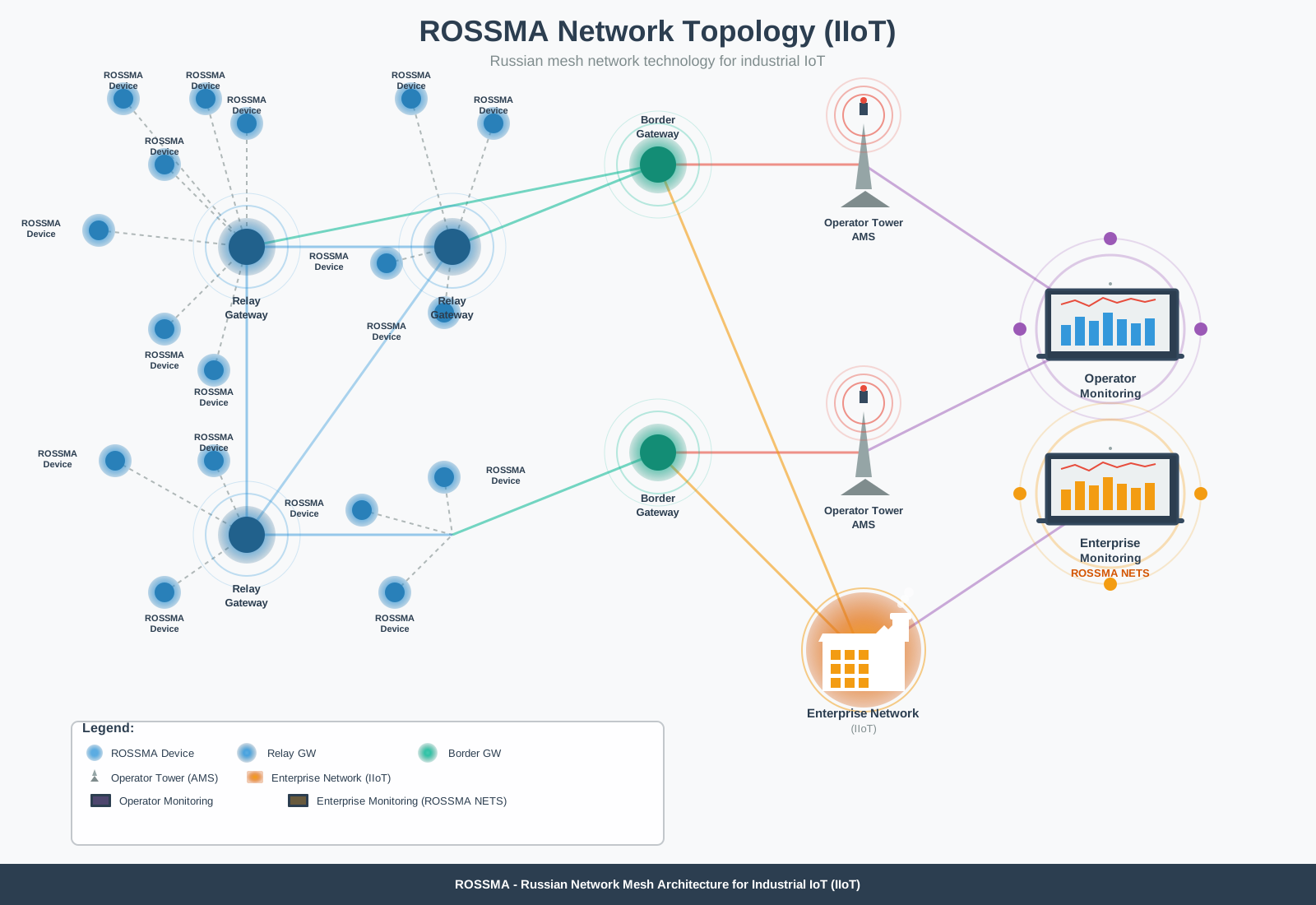
Figure 1. ROSSMA IIOT network topology with Mesh Gateway
Network Structure:
- Device zone: ROSSMA sensors and meters connected to nearest RBS
- Relay zone: RBS mesh network with multiple routes between nodes
- Border zone: PBS as gateway between mesh network and internet
- Connection zone: operator tower (AMS) or enterprise network (IIoT)
- Monitoring zone: ROSSMA NETS systems for network and device management
¶ Data Transmission Scheme
Typical sequence of data transmission from device to server:
Data path:
ROSSMA Device → RBS 1 (LoRaWAN, 868 MHz) → RBS 2 (Mesh) → RBS N (Mesh) →
PBS (aggregation) → Operator Tower (4G/Ethernet) → ROSSMA NETS (decryption, storage) →
Client Application (REST API/MQTT)
Packet delivery time depends on number of hops:
- 1 RBS: 2-5 seconds
- 3 RBS: 10-20 seconds
- 5 RBS: 30-60 seconds
¶ Mesh Advantages for IIoT
¶ 1. Extended Coverage
LoRaWAN Mesh extends operating range from 15 km (single gateway) to 100+ km (RBS chain), covering remote areas without operator infrastructure.
Coverage calculation:
Coverage = Number of RBS × 40 km (average distance between RBS)
Example: 3 RBS × 40 km = 120 km
¶ 2. Fault Tolerance
When one RBS fails, the network automatically rebuilds routes through neighboring stations. Data is buffered and sent after connectivity restoration.
Fault tolerance mechanism:
- Each RBS stores up to 3 alternative routes
- On primary route failure, traffic automatically switches to backup
- Data is saved to buffer (up to 10,000 packets) until connectivity restoration
- Backup route switching time: 5-10 minutes
Self-healing: LoRaWAN Mesh automatically adapts to topology changes, detecting new nodes and bypassing failed ones.
¶ 3. Scalability
Adding new RBS doesn't require reconfiguring existing network — nodes automatically discover each other and exchange routing tables.
Network scale:
- Up to 10,000+ devices in one mesh network
- Up to 50+ RBS in one cluster
- Up to 5 PBS for redundancy
¶ 4. Autonomy
RBS operate on solar panels (50-100W) and batteries (100-200Ah), providing independence from power grids. Typical autonomy: 7 days without sun (winter), unlimited (summer).
¶ 5. Cost Efficiency
Mesh topology reduces the number of expensive PBS with internet connection:
| Parameter | LoRaWAN | LoRaWAN Mesh |
|---|---|---|
| Coverage | 15 km | 100 km |
| Internet connection points | 1 per 15 km (5-7 PBS) | 1 per 100 km (1 PBS) |
| Infrastructure cost | ~$10,000 | ~$4,700 |
| Savings | — | 53% |
| Fault tolerance | Low | High |
| Deployment complexity | Low | Medium |
¶ ROSSMA Device Use Cases in LoRaWAN Mesh
¶ Oil & Gas Industry
Task: Monitoring 50 wells across an 80 km area without operator infrastructure
Solution:
- 50 ANALOG Ex devices (pressure, temperature measurement)
- 4 RBS (20 km spacing between nodes: 20 km, 40 km, 60 km, 80 km)
- 1 PBS at control base (0 km) with 4G/LTE connection
Network topology:
- Cluster 1 (0-20 km): wells 1-10 → RBS 1 (20 km)
- Cluster 2 (20-40 km): wells 11-20 → RBS 2 (40 km)
- Cluster 3 (40-60 km): wells 21-30 → RBS 3 (60 km)
- Cluster 4 (60-80 km): wells 31-50 → RBS 4 (80 km)
- Mesh route: RBS 4 → RBS 3 → RBS 2 → RBS 1 → PBS → ROSSMA NETS
¶ Other Applications
Pipeline Transport (200 km):
- 100 devices (VPM for valves, ANALOG for pressure, ESD for leaks)
- 12 RBS along pipeline, 2 PBS (start and end) for redundancy
- Fault tolerance: data flows both ways
Remote Settlements:
- Utility metering in villages without internet
- 1 RBS in village center, PBS at nearest operator tower
- Automated metering without cable laying
¶ LoRaWAN Mesh Network Deployment
¶ Network Planning
Main steps:
- Define coverage area boundaries and calculate number of RBS:
(Distance / 40 km) + 1 - Select RBS installation locations (topography, line of sight)
- Assess power supply (power grid or solar panels)
- Plan backup routes (minimum 2 paths to PBS)
- Determine PBS connection points (operator tower or enterprise network)
¶ Installation and Configuration
Deployment steps:
-
PBS Installation:
- Mount antennas at 10-15m height (tower, building roof)
- Connect to internet (Ethernet or 4G/LTE)
- Configure ROSSMA NETS connection (MQTT/HTTPS)
- Time synchronization (GPS/NTP)
-
RBS Installation:
- Mount antennas at 10-15m height
- Connect power (220V AC or solar panels + battery)
- Register in ROSSMA NETS (via PBS)
- Check connectivity with neighboring RBS (visualization in ROSSMA NETS)
-
Device Registration:
- Add devices in ROSSMA NETS application
- Test connectivity (uplink/downlink)
- Verify routes (packet tracing)
Typical deployment timeline (100 km project with 5 RBS and 100 devices):
| Stage | Duration |
|---|---|
| Site survey and network design | 8 days |
| PBS installation | 2 days |
| RBS installation (5 units) | 7 days |
| Mesh routes configuration | 2 days |
| Device registration (100 units) | 3 days |
| Connectivity testing | 5 days |
| Staff training and commissioning | 2 days |
| Total | ~29 days |
¶ Monitoring and Diagnostics
ROSSMA NETS Tools:
- Real-time network map with topology visualization
- Link quality metrics (RSSI, SNR, packet loss) for each RBS
- Packet tracing with complete route and timestamps
- Alerts on RBS failure or device connectivity loss
- Data volume and channel load statistics
¶ Technical Specifications
¶ Frequency Plan
LoRaWAN Mesh uses RU864 frequency plan (863-870 MHz):
- Devices → RBS: 868.9-869.1 MHz (join requests, uplink)
- Mesh (RBS ↔ RBS): 866.1-867.9 MHz (relay with LBT)
- RBS → PBS: 864.1-864.9 MHz (transmission to border stations)
LBT (Listen Before Talk): RBS listens to channel before transmission to avoid collisions.
Learn more: LoRaWAN Frequency Plan
¶ Security
LoRaWAN Mesh provides end-to-end encryption from device to server:
Protection layers:
- Application Layer: payload data encryption (AES-128, AppKey)
- Network Layer: device and server authentication (NwkKey)
- Mesh Layer: mesh traffic protection between RBS (MeshKey)
Security mechanisms:
- Unique keys for each device (DevEUI)
- Replay attack protection (FCntUp/FCntDown counters)
- Message integrity check (MIC)
- RBS authentication in mesh network
- TLS/SSL for data transmission from PBS to server
RBS cannot decrypt device payload data — they only see mesh headers for routing. End-to-end encryption ensures confidentiality from device to ROSSMA NETS.
¶ LoRaWAN Integration
LoRaWAN Mesh is an extension of the LoRaWAN standard, not a replacement. Devices operate using LoRaWAN 1.0.3/1.1 protocol, support classes A and C, compatible with any LoRaWAN devices.
ROSSMA devices are not aware of mesh topology — they operate as regular LoRaWAN devices. Mesh routing happens transparently at the RBS level.
Operating principle:
- Device → LoRaWAN uplink (AES-128 encryption, 868 MHz)
- RBS → uplink reception, mesh route selection, relay
- PBS → data aggregation, transmission via Ethernet/4G
- ROSSMA NETS → decryption, database storage, API provision
Compatibility:
- Devices: any LoRaWAN 1.0.3/1.1 class A/C
- Server: ROSSMA NETS (compatible with LoRaWAN Network Server)
- Frequency plan: RU864 (GOST R 71168-2023)
LoRaWAN basics: LoRaWAN Technology
¶ LoRaWAN Mesh FAQ
How many RBS can be chained together?
Technically — up to 10 RBS. Practical recommendation: no more than 5 to minimize delays (30-60 sec for 5 RBS).
What happens when an RBS fails?
LoRaWAN Mesh automatically rebuilds routes through neighboring RBS (self-healing):
- RBS periodically send beacon packets (every 60 sec)
- On connectivity loss (5 minutes) node is marked as unavailable
- Traffic automatically switches to backup route
- Data is buffered (up to 10,000 packets) until connectivity restoration
Can RBS be used without PBS?
No, to transmit data to ROSSMA NETS, at least one PBS with internet connection is required. RBS only operate as part of mesh network with PBS at the edge.
What is the maximum mesh network throughput?
Typical parameters:
- One RBS: up to 1000 devices × 1 message/hour
- Mesh network (5 RBS): up to 5000 devices × 1 message/hour
Recommendations: 1 message every 15-60 minutes for mass measurements, 1-5 minutes for critical sensors.
Does LoRaWAN Mesh support downlink (server commands)?
Yes, downlink commands are supported for class A and C devices.
Delivery time: class C (10-60 sec via mesh), class A (depends on uplink period).
¶ Additional Materials
Related pages:
- LoRaWAN Technology — protocol basics, RU864 frequency plan
- ROSSMA System Architecture — complete IIoT platform architecture
- Quick Start — connecting devices to ROSSMA NETS
- Device Catalog — ROSSMA equipment lineup
- ROSSMA NETS Server — network and device management
Support:
- Technical support: support@rossma.ru
- Official website: rossma.ru
¶ Summary
LoRaWAN Mesh — self-organizing network technology for industrial IoT, enabling fault-tolerant monitoring systems over 100+ km distances without telecom operator infrastructure. ROSSMA IIOT-AMS devices are fully compatible with LoRaWAN Mesh.
Key advantages:
- ✅ Coverage extension up to 100+ km (vs 15 km in LoRaWAN)
- ✅ Fault tolerance with automatic route switching
- ✅ 50%+ infrastructure cost savings (fewer PBS)
- ✅ RBS autonomy on solar panels
- ✅ LoRaWAN standard compatibility
- ✅ ROSSMA IIOT-AMS devices manufactured in Russia, GOST R 71168-2023 support
Applications: oil & gas industry, pipeline transport, remote sites, utilities, industrial automation.